Proton, the Swiss-based tech company which provides privacy-focused online tools and apps, counts transparency as one of their core tenents. All Proton apps are open source and independtly audited by security experts, in part to prove that the security measures they have in place can be proven and verified.
As part of that commitment to transparency, Proton regularly publishes a report on how many court-ordered data requests they receive, and how many have resulted in user data being provided.
One of the attractive features of Proton VPN, and all Proton products, is that the infrastructure is housed in Switzerland and governed by the strictest privacy laws on the planet. This means that unless a foreign government can convince the Swiss government to bring forward a privacy request, Proton does not have to honour it.
Proton VPN literally cannot comply with privacy requests for one simple reason.
Under Swiss law, Proton is not required to keep connection logs and adheres to a no-logs policy. This means that Proton cannot provide the information being requested even if they wanted to because Proton doesn't have it. In the first half of 2026, Proton VPN received 47 privacy requests from the Swiss government, and all resulted in no user data shared for this exact reason.
As of June 2026, Proton VPN has received 458 such requests from the Swiss government, all unsuccessful.
Requests for Proton Mail data are higher, with 9301 requests received in 2025 (first half of 2026 data is not currently available); 988 requests were denied and metadata only was provided for the remaining 8313 (more on that below).
By contrast, the US government makes approximately 500,000 data requests to US-based tech companies each half year, and it is estimated anywhere from 70%-90% are complied with and the requested data provided.
The following is a breakdown of the information Proton can and cannot provide.
Can Share (Metadata):
- Account registration details such as name and address
- Recovery email addresses
- IP addresses at login/activity times (but not if Proton VPN is enabled)
- Device information
- Account creation/deletion dates
- Billing information
Cannot Share (Personal data):
- Email contents
- Attachments
- Encryption keys
- Any decrypted user data
How does this compare to other tech companies?
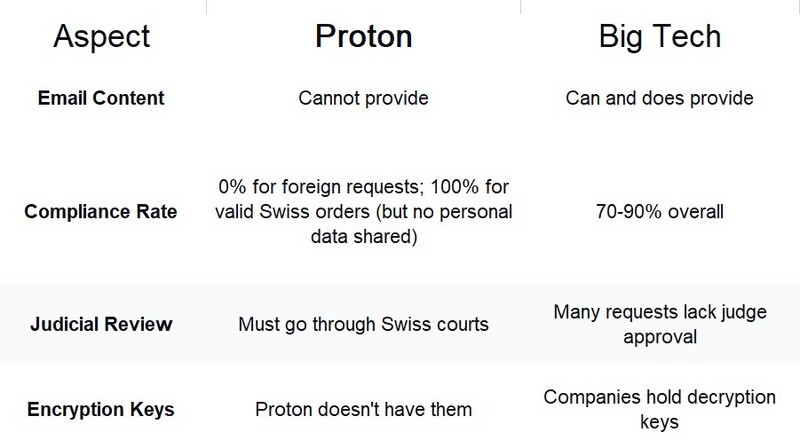
Part of the appeal of Proton is protection from legislation like the US Cloud Act, which can compel US-based VPNs to do the following:
- Compelled log tracking: A US-based VPN company could be ordered to begin logging a specific users activities, even if the company has a no-logs policy.
- Existing logs: Even with a claimed no-logs policy, any data that is collected can be ordered preserved and surrendered.
- Gag orders: Companies may not be permitted to tell a user their activities are being logged.
Ready to try Proton VPN?
Proton VPN is available both for free and as a paid service. The paid version can be bundled with Proton Unlimited or purchased as a standalone service, with a 70% discount if you're prepared to sign up for 2 years.
If you would like to view the Proton privacy reports yourself, the Proton VPN report can be found here and the Proton Mail report here.
Read more

Do you get free access to Proton apps with AphyOS?
Big Tech productivity apps aren't really free; while they may not charge money, they are harvesting your data and selling it to the highest bidder, or with the stroke of a pen may be providing it to national governments. Enter Proton, where Swiss privacy laws and dedication to data security meet to provide a truly free-to-use suite of mobile productivity applications. Learn more about...

The actual cost of "free" online services
While services provided by Big Tech may not cost you money, they do cost your privacy. This article explores how companies like Google make billions of dollars by tailoring custom advertisements to the individual by collecting data on them via multiple methods.

Why you want to pay for Proton (and maybe why you don't)
Proton provides a suite of productivity applications that combine convenience and ease of use with enhanced data protection and privacy. Explore why upgrading from the free Proton apps to the paid versions is likely right for many users, but maybe not all.
New and improved Proton Drive
Proton Drive has been upgraded, with enhanced speeds, greater sharing control, new viewing options (particularly of note for photo sharing), and more. Proton Drive is available for free or for purchase.